BY: JON GROVE
JOINT REPLACEMENTS ARE SERIOUS SURGERY. TO SOMEONE WHO LIFTS WEIGHTS, THE FEAR OF THE UNKNOWN AND OF NO LONGER BEING ABLE TO PARTAKE IN WHAT YOU LOVE TO DO CAN BE OVERWHELMING. HIP AND KNEE REPLACEMENTS ARE NOT THE END BUT THE BEGINNING OF A REIMAGINED JOURNEY. WITH THE CORRECT APPROACH, YOU CAN STILL SQUAT AND DEADLIFT HEAVY WEIGHTS.
I’ve trained with heavy barbells for the majority of my life. I was once described by a supplement sponsor as “a powerlifter’s powerlifter” which simply meant I was a hard-core purist who looked, talked, acted, ate, slept and lived the part. This was an accurate statement; when I say I “trained with heavy barbells” I’m talking about the compound basics (squats, bench presses and deadlifts) and a lot of them.

For me, there weren’t “deload” weeks and I didn’t talk about R.P.E. (rate of perceived exertion) scales related to waving intensity effort. Whether high reps or heavy singles I had the dial turned all the way up on every lift, every set, every day. In retrospect, it is no real surprise that I had to have my hip replaced at 43 years old.
I didn’t write this to define my obvious lack of self-restraint in the gym or to discuss what steps I could have taken to avoid multiple joint replacements at a young age. Instead, I wanted to outline how having an artificial joint is not as limiting in the gym as people think. I’m sure a lot of orthopedists would disagree with me, but I come to this observation from real life perspective that few have experienced, and I remember searching the internet several years ago for information about squatting and deadlifting after hip replacement surgery and finding very little information. In some cases, I read advice to never lift more than 50 pounds again!! My base of knowledge comes from being an avid lifter, having my hip replaced, pushing my hip replacement to its limits until cracking the lining, having a hip revision surgery and still training hard but with far greater insight on what you can and can’t do. I wanted to explain the realities of training hard after hip arthroplasty.

Hip replacements are made of a titanium alloy. The name “Tritanium” is the registered trademark used by manufacturers of these prosthetics. This describes an immensely strong metal that is specially designed to graft to the bone. The lining is comprised of a high strength cross-linked Polyethylene plastic that has a very slow wear rate. It’s also a very strong material. In many ways, a new hip replacement is stronger than the original. The weak link is the actual implant in the femur itself and allowing the components enough time to adhere to the bone. There are definite precautions, but a hip replacement is designed to bear weight and walk right out of surgery.

I believe the biggest obstacle for many people post-surgery is lack of muscle strength. I have met a lot of older adults that tell me it was difficult regaining function, and I finally realized that a fresh new joint might alleviate pain, but it is only functionally as good as the soft tissue around it. If someone is in extreme pain for a long time, they tend to alter their movement patterns and decrease activity but this, in turn, creates imbalances and weakness in the tissues surrounding the hip. I was a 43-year-old weightlifter, so my bone density was ideal for the implant and my muscles, tendons and ligaments remained strong. I had never stopped lifting hard and finding ways to work around the injury. I believe inactive individuals should do some focused strength training prior to surgery under the supervision of someone that knows how to select the correct exercises to allow them to be more mobile and heal faster post-surgery.
I chose not to go to a physical therapist for my hip. One of the exercises therapists recommend is holding the edge of the kitchen sink and sitting back into a knee bend (aka: squat). After a few weeks of healing and regaining basic mobility, I replicated this physical therapy squat by incorporating specially made handles on my power rack in my garage gym and I squatted down to a bench above a parallel position. I used my bodyweight and did sets of 10 repetitions. I sat lightly on the bench with a slow descent and then stood up by pressing through the heels. As the weeks progressed, I added a 20-pound chain draped around my neck then a 65-pound Safety Squat Bar; I continued doing sets of 10 reps. Eventually I added 40 pounds of chain weight to the bar which allows the weight to decrease as you get into the lower, more compromised position. Using traditional strength training methods, I progressively added weight plates to the bar then chain then weight then chain until I was using 245 pounds for 10 reps. Over a few months I slowly added in some regular barbell squats and some higher repetition hip-friendly leg presses. I won’t layout every step, but my approach was to steadily add resistance, range of motion and finally remove the bench until I was squatting again.
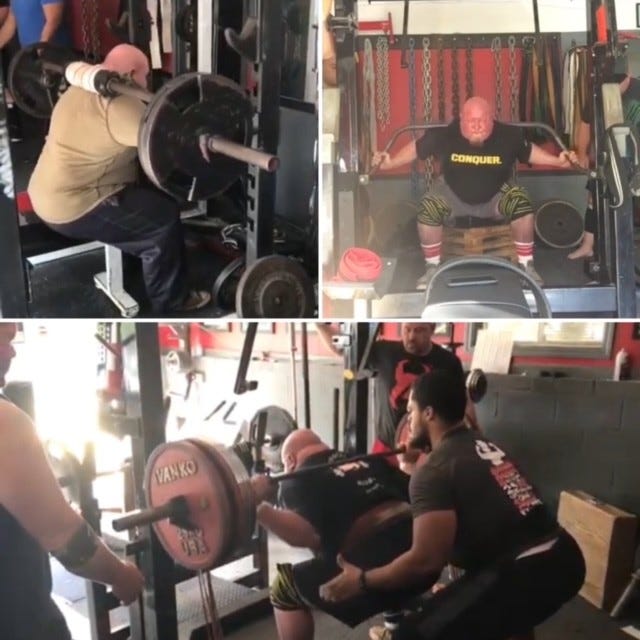
In an effort to keep this brief, I regained much of my squatting strength and, though my competitive powerlifting was over, I still cherished every training session with my friends and felt very confident going heavy each week. I would change many variables of the exercise but going heavy was always a constant. I need to emphasize that “heavy” is all relative and I squatted to a defined box height a lot, but I would go over 500 pounds consistently, over 600 pounds every few weeks and over 700 pounds on occasion. These, to me, were light weights comparatively and my hip felt great. The heaviest weight I put on the prosthetic was around 670 pounds plus 100 pounds of added chain weight; the implant was fine doing a parallel squat with 770 pounds. Everything appeared to be fine, but I made two major mistakes that I can now share with other weightlifters who have their hips replaced but still desire to train.
First off, I do not consider lifting 600 or 700 pounds one of my mistakes and I wouldn’t change this. My muscles, bones and lifting technique were trained for these loads over decades. The titanium and polyethylene aren’t a limiting factor with these miniscule weights either. I truly believe I could have lifted greater loads for far longer, but I learned two important things. The first is frequency. This seems obvious but I always stayed hyper fixated on my weekly training schedule and looked forward to each and every workout. Missing a training day or just deloading my body with some light leg exercises was unfathomable to me. However, if I had cycled my training in a way where I only went heavy two times per month, I could have maintained strength with 50% of the wear and tear. I needed to be less focused on “squat day” and more on how I felt and progression over a greater time period. It was less about what I was doing and more about how often.
My second hip replacement mistake is the “straw that broke the camel’s back”. It’s one of the precautions outlined by surgeons and therapists to hip replacement recipients. “Avoid bending the hip past 90 degrees”, they say. In contrast, powerlifters call anything above 90 degrees a “high” squat. In competition, a legal lift is defined by the top of the thigh (hip crease) going lower than the top of the knee. This is verbalized as “below parallel”. I had been conditioned to squat to parallel or below since I was 15. Post hip replacement I would often set a fixed box height to above this to limit my depth with the heaviest sets, but I’d still enjoy dropping back to 500 pounds for 5 reps or so and really “burying” them deep with these “lighter weights”. The problem with this is (a) a human body doesn’t know that 500 pounds is “light” and (b) a hip replacement isn’t designed to articulate safely below 90 degrees. The ball rotates in the acetabular cup but at a deep enough point it can dislocate or create damage to the polyethylene lining. If you add heavy weights, repetitions and weekly battering to this equation, you set up an ideal situation for cracking the lining of the artificial hip beyond proper function. I cracked the lining of my acetabular cup.

Modern artificial hip replacements are built to withstand far more pressure and force than expected by normal activity. People return to running, skiing, riding dirt bikes, mountaineering, martial arts and many other physically demanding endeavors. Lifting barbells is no different. In fact, after 6 years of heavy lifting my joint showed almost no appreciable wear. These materials are expected to show about 10% wear after a decade but mine was shiny, smooth, and tight. The weights and reps themselves had not damaged these high strength materials. It was ultimately the heavy weights dropped below 90 degrees repetitively that caused a crack in the lining and shifting of the joint. The surgeon was so surprised by this cracking that my hip lining was placed in a specimen jar and presented to Stryker, the manufacturer of the prosthetic.
Hip replacements are modular, though I don’t know that physicians would like to think of them in that way. I did not have to have a second full hip arthroplasty but rather a hip “revision” surgery. This is a longer procedure, but, in my case, it involved replacing the polyethylene on both the ball and socket without having to do anything further to the bone. It’s still an invasive and serious surgery but I went home that evening, walked up the stairs and cooked dinner.
I followed the same procedure to get back to lifting weights. It’s always easier when you know what to expect. This time, I constructed a 17-inch-tall box to squat to and I no longer felt the need to go much over 500 pounds. In fact, I changed my training emphasis, and the “powerlifter’s powerlifter” became more focused on hypertrophy training and high intensity style “bodybuilding” methods. This allows me to pre-exhaust my legs and use barbell squats as a secondary exercise with lighter weights, with more focus on the quadriceps and with less torque and pressure on the hips.
The good news is that you don’t have to eliminate heavy barbells from your training if you love to squat and deadlift. These new joints are stronger than any part of your natural body. Whether you’re a competitive lifter, a bodybuilder or just a person who enjoys a full body weight training routine, be cautious, read your body and avoid heavy squats below 90 degrees and this new hip should be no different than the one you were born with!!
Disclaimer: I’m sure most medical practitioners would not agree with any or all of my article. Their goal is to get people healthy and able to perform day to day routine activities. I’m not a medical doctor nor a licensed Doctor of Physical Therapy. I squatted over 700 pounds as a teenager, 832 pounds at 22 and over 900 pounds in competition 5 times. My perception of a heavy weight on the human body is based on my experiences and not typical.